Siding Cleaning
Siding cleaning is our house wash — the same service, under the name most people search for. Material-specific cleaning for vinyl, aluminum, brick, stucco, EIFS, painted wood, cedar and fiber cement, each cleaned with the method and solution it tolerates, and priced on the square footage of your home.
$249 to $879, by the square footage of your home. Every price is published, so you get a number without a visit or a phone call.
Our Process
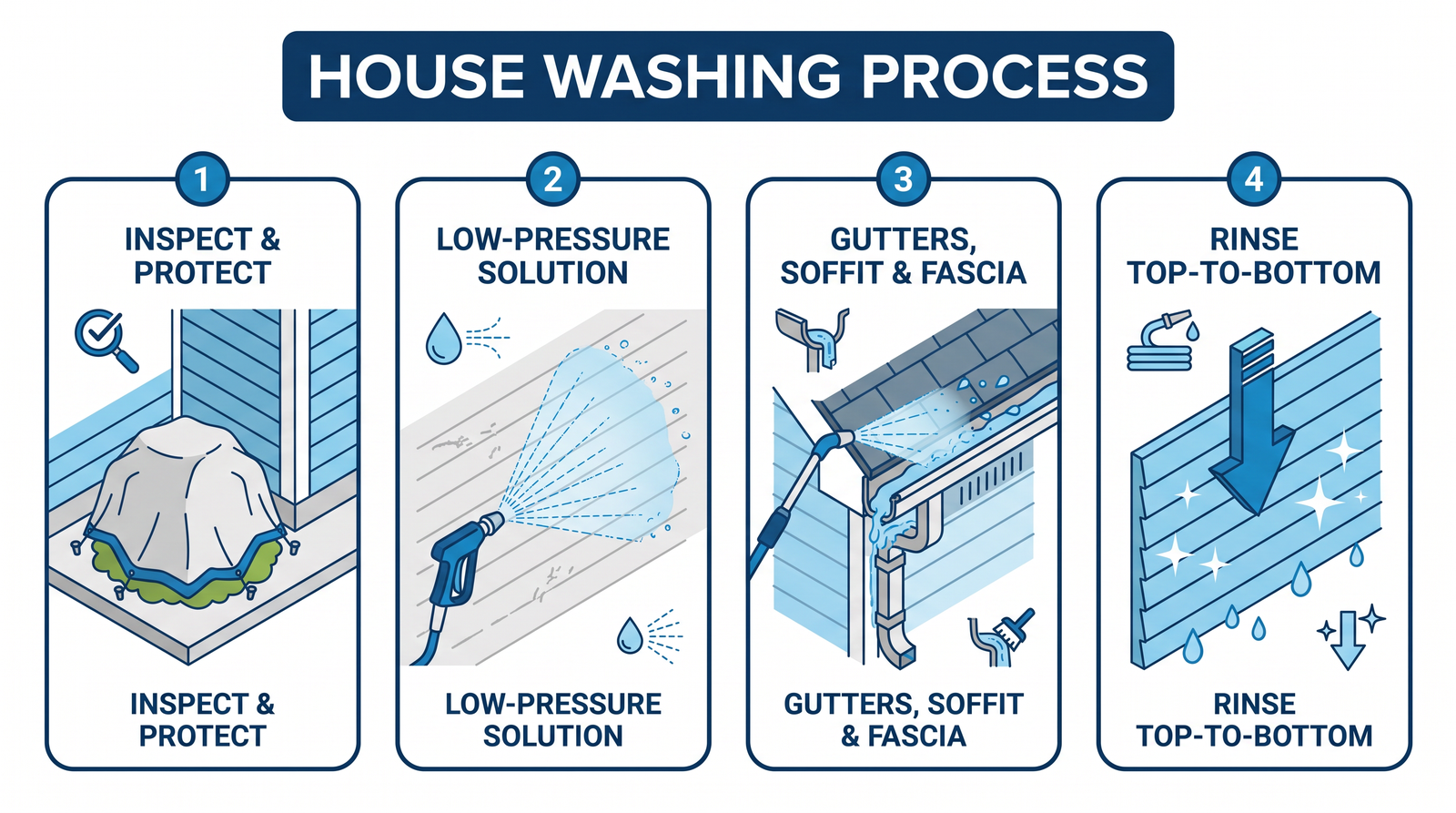
1. Identify Material & Problem Areas. We identify the siding material and the specific problem areas before starting.
2. Protect & Apply. We protect nearby plants and fixtures, then use a controlled low-pressure application.
3. Siding Surfaces Only. This service covers the siding itself. Eaves, soffit, fascia, gutter faces and the garage door are part of a full house wash rather than this one — worth knowing before choosing between them, because the price difference is smaller than the scope difference.
4. Top-to-Bottom Rinse. We rinse from top to bottom for an even result.
Siding Cleaning by town
Where a town’s own surfaces are worth writing about separately, it has its own page — the same prices, with what actually weathers there and the sales tax for that county stated on it.
Our guarantee
If you are not satisfied with a surface we cleaned, tell us within 14 days and we will come back and re-clean it at no charge.
The guarantee covers cleaning. It does not cover conditions cleaning cannot correct — oxidized or chalked finishes, concrete scaling where the surface has already broken loose, failed paint or stain, and rust with an active source still feeding it. We identify those on the walkthrough and tell you before any work begins.
Common Questions
Why is oxidation treatment separate from the house wash?
Because a house wash is built not to strip the finish, and that is the right way round. Oxidation is the chalky film on aged vinyl and aluminum — the white powder that comes off on your hand. It is not dirt. It is pigment that has left the coating under years of sunlight; aluminum manufacturers describe their finishes as formulated to chalk in a controlled manner, releasing powdery particles of pigment over time. A wash takes the loose powder off, and manufacturers expect that — it is ordinary maintenance. What a wash cannot do is put the pigment back, so a badly chalked wall comes out genuinely clean and can still look flat and faded. The wash has done exactly what it should. What it will not do is strip the degraded layer, and that is deliberate. Pressure, stiff brushes and abrasive cleaners take that layer off along with patches of the finish — CertainTeed does not recommend power washing vinyl siding at all, and the Vinyl Siding Institute warns that stiff bristles can change the gloss and leave siding looking splotchy. Our soft wash leaves the finish alone on purpose. That is why oxidation treatment is its own service, and why it is always done after the wash: you cannot judge a finish until the dirt is off it. Once the treatment is done, its result is covered by the same guarantee as the rest of the work. Heavily degraded siding improves rather than returning to its original color, and we tell you which of the two we expect before you agree to it. Usually only the elevations that take the most sun need it at all. What the roof warranty covers, and how it compares to the five-year ones you will see online, is set out in [how to read a roof cleaning warranty](/learn/roof-cleaning-warranty-what-five-year-really-means). Roof pricing is on the [roof soft washing page](/services/roof-soft-washing). Why a wash leaves chalky siding chalky-looking, and what actually improves it, is explained in [why a wash will not bring the color back](/learn/why-a-house-wash-will-not-fix-chalky-siding).
Will pressure washing remove that chalky residue or fix oxidized siding?
No. Washing removes dirt, pollen, and organic growth sitting on the siding, but oxidation is the siding's own surface layer breaking down, not something sitting on top of it. On siding that's already chalked unevenly, an aggressive wash can lift some of that loose surface film and not the rest, leaving it looking blotchier than before. Our standard wash uses a controlled, low-pressure approach so it cleans evenly without making existing oxidation worse. Restoring color under the chalk is a separate, optional treatment we offer on request. Why a wash leaves chalky siding chalky-looking, and what actually improves it, is explained in [why a wash will not bring the color back](/learn/why-a-house-wash-will-not-fix-chalky-siding).
Learn More — what siding oxidation is and why pressure washing won't fix it
Can faded color on oxidized siding be brought back?
Often yes, as an optional treatment separate from a standard wash. A house wash removes the dirt and organic growth sitting on the siding; restoring color means treating the oxidized surface layer itself, which is a different product and a different process. How much comes back depends on how far the oxidation has progressed and how evenly the panel has chalked, and heavily degraded siding can improve without returning to its original color. We look at the siding and tell you what is realistic before you commit to it. Why a wash leaves chalky siding chalky-looking, and what actually improves it, is explained in [why a wash will not bring the color back](/learn/why-a-house-wash-will-not-fix-chalky-siding).
Learn More — what siding oxidation is and why pressure washing won't fix it
Why would one wall of my Louisville house need a different mix than another?
Because the subdivisions here arrived in waves, siding age varies a lot inside a single block — and sometimes inside a single house, where an addition is twenty years newer than the original. Vinyl and aluminum that has faced the sun for decades chalks and oxidizes, while the shaded elevation on the same house is carrying organic growth instead. Those are two different problems with two different solutions, so we walk the full perimeter with you on the day and confirm the estimate you already have rather than guessing from the driveway, and we adjust chemistry per elevation instead of per neighborhood. The written scope names each surface so you can see what is being treated where. Why a wash leaves chalky siding chalky-looking, and what actually improves it, is explained in [why a wash will not bring the color back](/learn/why-a-house-wash-will-not-fix-chalky-siding).
My Stow siding looks dull and leaves powder on my hand. Is that dirt?
No, that is oxidation, and knowing the difference is the most useful thing we can tell you here. Vinyl and aluminum installed in the seventies and eighties chalks on the south and west elevations — the finish itself has broken down into a dull, powdery surface. A plain rinse just wets it down and it looks the same once it dries, which is why people feel let down by a standard wash. Oxidation treatment is what improves it — done after the wash, and it improves the finish rather than restoring the original color. We check for chalking on the walk-through and tell you which elevations have it, so you are buying the service that matches the condition. Why a wash leaves chalky siding chalky-looking, and what actually improves it, is explained in [why a wash will not bring the color back](/learn/why-a-house-wash-will-not-fix-chalky-siding).
Learn More — what siding oxidation is and why pressure washing won't fix it
My Wooster split-level looks faded rather than dirty. Can washing fix that?
Washing will not fix it. In the established communities the split levels and ranches are the oxidation jobs — siding chalked to a dull, powdery finish on the exposed elevations, where the finish itself has broken down. A rinse wets it and it dries back to the same look, which is why a standard wash disappoints on those houses. Oxidation treatment is what improves it — always after the wash, and on heavily degraded siding it improves the look rather than bringing the original color back. On the walk-through we check for chalking by hand, tell you which elevations have it, and quote the service that matches the condition we found rather than the one that sounds cheaper. Why a wash leaves chalky siding chalky-looking, and what actually improves it, is explained in [why a wash will not bring the color back](/learn/why-a-house-wash-will-not-fix-chalky-siding).
Learn More — what siding oxidation is and why pressure washing won't fix it
What is the difference between soft washing and pressure washing?
Soft washing uses low pressure and surface-appropriate cleaning solutions for delicate materials such as many roofs and siding types. Pressure washing is generally reserved for durable hard surfaces, such as applicable concrete. SurfaceWorks ProWash selects the method based on the material, condition, and project scope.
What is the difference between gutter cleaning, a gutter clean-out and gutter brightening?
Three different jobs on the same piece of metal. Gutter cleaning is the outside face of the gutter and downspout. It comes with a house wash or a siding cleaning at no extra cost. A gutter clean-out is interior work: removing packed leaves, shingle grit and sediment from inside the trough, then flushing each downspout to confirm water runs through it. It is included free with roof soft washing, because roof work puts debris into the gutters by design. It is also sold on its own, priced per linear foot, with no other service required. Gutter brightening removes the dark vertical striping bonded to the front face, often called tiger striping. That is oxidized aluminum and road film chemically stuck to the finish, so it needs a dedicated product and will not come off with house wash solution. It is never included in a house wash. A quick way to tell what you need: if the inside is full, you need a clean-out. If the outside is streaked dark, you need brightening. If neither, the cleaning that comes with your wash is enough. The gutter clean-out is free with a roof soft wash and 25% off added to a house wash, and the rate is published on the [pricing page](/pricing). More on what the gutters do to a roof in [black streaks, moss and lichen](/learn/roof-moss-lichen-algae-damage). Why a wash leaves chalky siding chalky-looking, and what actually improves it, is explained in [why a wash will not bring the color back](/learn/why-a-house-wash-will-not-fix-chalky-siding). You can get your own number right now: the [instant estimate](/instant-estimate) prices your property from the address in about two minutes, and what you accept is what you pay.
Why does my siding have a chalky white residue on it?
That's oxidation, not dirt. Vinyl siding is made with pigment and UV-resistant additives that slowly break down under years of sun exposure, and the fine powdery film left behind is the byproduct of that breakdown. It's a normal part of how siding ages, most visible on sun-exposed and darker-colored siding, and isn't a sign of a problem with the material or a prior cleaning. Why a wash leaves chalky siding chalky-looking, and what actually improves it, is explained in [why a wash will not bring the color back](/learn/why-a-house-wash-will-not-fix-chalky-siding).
Learn More — what siding oxidation is and why pressure washing won't fix it
My street has 1950s brick colonials next to brand-new builds. Does that change how they are cleaned?
Because the mixed age of the housing stock here is the whole story. A brick colonial from the 1950s and a 2020s build with stone veneer and fiber-cement trim need different chemistry, different pressure and different rinse discipline, and running one process across both is exactly how siding gets streaked. Those two houses can sit a few streets apart. So the walk-through starts by identifying what your elevations are actually made of, and the method follows from that rather than from a neighborhood-wide assumption. The difference is not cosmetic: the same process that is right for stone veneer and fiber cement will streak a 1950s brick elevation.
More questions answered on the full FAQ page.