
Concrete Cleaning
Surface-specific cleaning for concrete surfaces such as patios, walkways, and pads.
$119 to $819, by measured area. Find your size in the table below — every price is published, so you get a number without a visit or a phone call.
Concrete Cleaning Prices
Sidewalks, walkways, porches, pads and slabs, by measured area.
| Size | Price | Added to a house or roof wash | Typical time on site |
|---|---|---|---|
| Up to 500 sq ft | $119 | $95 | 1 hr |
| 501 - 1,000 sq ft | $145 | $116 | 1 hr 30 min |
| 1,001 - 1,500 sq ft | $259 | $207 | 1 hr 45 min |
| 1,501 - 2,000 sq ft | $319 | $255 | 2 hr |
| 2,001 - 2,500 sq ft | $389 | $311 | 2 hr 30 min |
| 2,501 - 3,000 sq ft | $449 | $359 | 2 hr 45 min |
| 3,001 - 3,500 sq ft | $529 | $423 | 3 hr 15 min |
| 3,501 - 4,000 sq ft | $619 | $495 | 3 hr 45 min |
| 4,001 - 4,500 sq ft | $719 | $575 | 4 hr 15 min |
| 4,501 - 5,000 sq ft | $819 | $655 | 4 hr 45 min |
Added to a house wash or roof soft wash, this comes at the add-on price. The saving is real rather than a discount dressed up: the drive, the hookup, the mix and the pack-down are paid for by the first service on the visit, so the second one genuinely costs us less to do.
Included: Surface cleaning and an algaecide post-treatment.
Not included: Oil, rust and paint stains are treated separately. Sealing is quoted per job.
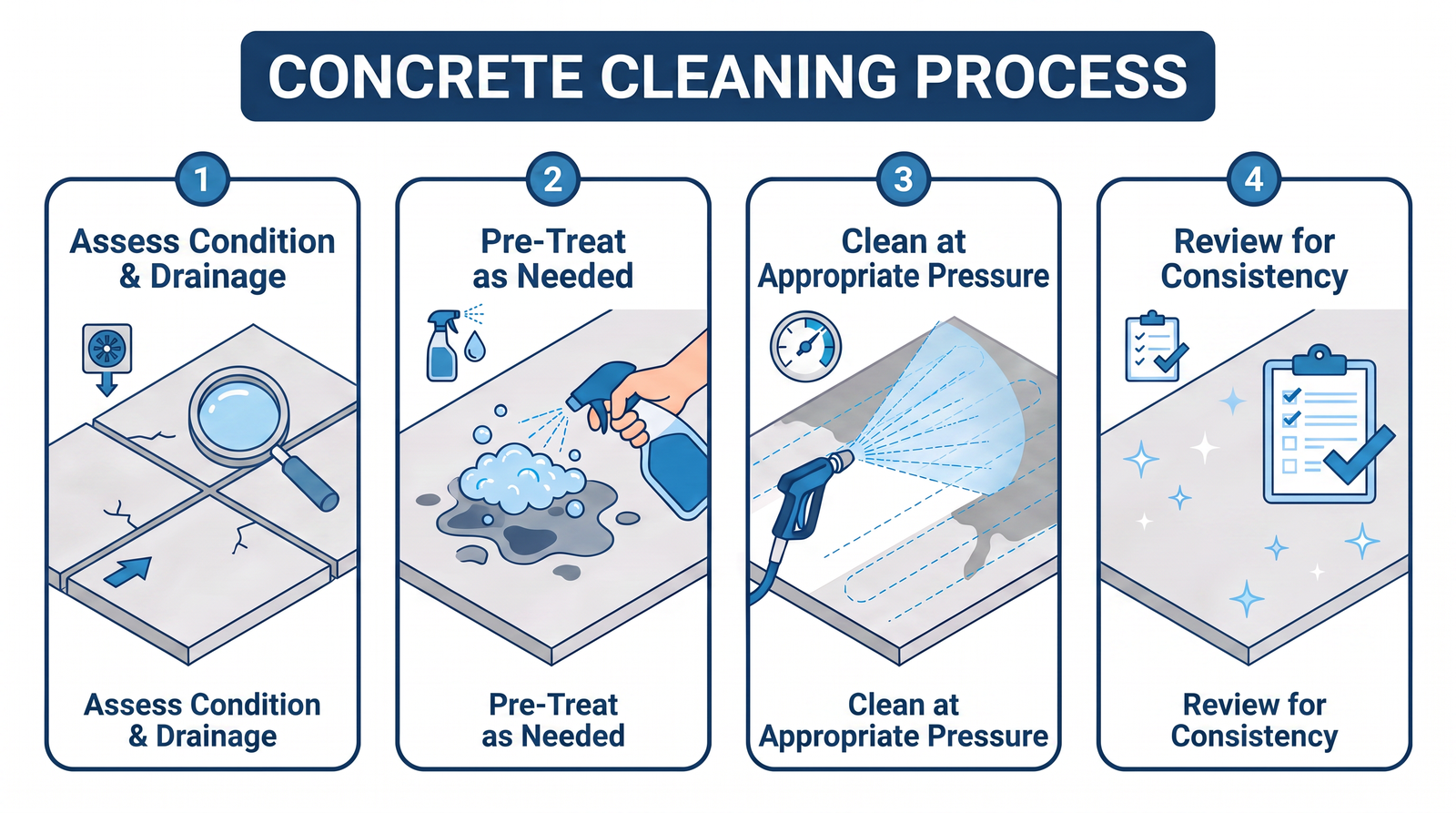
Condition, joints and drainage get assessed first, spots are pre-treated, then the flatwork is cleaned in controlled passes at a pressure the concrete tolerates and reviewed for consistency before we move on. Where flatwork meets landscaping or a different material, the transition is detailed by hand.
Concrete looks uniform and is not. Age, finish, how it was cured and how much salt it has taken all change what it will give up, and two slabs poured the same year at the same house can behave differently. Working to the surface in front of us rather than to a fixed setting is the difference between an even result and a patchwork. Drainage matters as much as pressure: solution and lifted soil have to leave somewhere, and that somewhere should not be a flower bed or a window well.
What to expect: Expect an even, uniformly lighter surface rather than a bright white one — concrete cleans back to its own colour, not to new. Shaded flatwork under trees will start greening again sooner than open slabs, which is what the algaecide is for.
Worth adding: Concrete Sealing. Sealed concrete holds its result up to about three years rather than one, and it keeps salt out of the surface over winter instead of letting it soak in. It is quoted per job, and it only works on concrete that is genuinely clean and fully dry first.
Condition, joints and drainage get assessed first, spots are pre-treated, then the flatwork is cleaned in controlled passes at a pressure the concrete tolerates and reviewed for consistency before we move on. Where flatwork meets landscaping or a different material, the transition is detailed by hand.
Concrete looks uniform and is not. Age, finish, how it was cured and how much salt it has taken all change what it will give up, and two slabs poured the same year at the same house can behave differently. Working to the surface in front of us rather than to a fixed setting is the difference between an even result and a patchwork. Drainage matters as much as pressure: solution and lifted soil have to leave somewhere, and that somewhere should not be a flower bed or a window well.
What to expect: Expect an even, uniformly lighter surface rather than a bright white one — concrete cleans back to its own colour, not to new. Shaded flatwork under trees will start greening again sooner than open slabs, which is what the algaecide is for.
Worth adding: Concrete Sealing. Sealed concrete holds its result up to about three years rather than one, and it keeps salt out of the surface over winter instead of letting it soak in. It is quoted per job, and it only works on concrete that is genuinely clean and fully dry first.
Our Process
1. Assess Condition & Drainage. We assess the concrete's condition, joints, and drainage before starting.
2. Pre-Treat as Needed. Applicable buildup is pre-treated as needed.
3. Clean at Appropriate Pressure. We clean with pressure appropriate to the surface.
4. Review for Consistency. We review the result for a consistent finish.
Concrete Cleaning by town
Where a town’s own surfaces are worth writing about separately, it has its own page — the same prices, with what actually weathers there and the sales tax for that county stated on it.
Our guarantee
If you are not satisfied with a surface we cleaned, tell us within 14 days and we will come back and re-clean it at no charge.
The guarantee covers cleaning. It does not cover conditions cleaning cannot correct — oxidized or chalked finishes, concrete scaling where the surface has already broken loose, failed paint or stain, and rust with an active source still feeding it. We identify those on the walkthrough and tell you before any work begins.
Common Questions
What is the difference between soft washing and pressure washing?
Soft washing uses low pressure and surface-appropriate cleaning solutions for delicate materials such as many roofs and siding types. Pressure washing is generally reserved for durable hard surfaces, such as applicable concrete. SurfaceWorks ProWash selects the method based on the material, condition, and project scope.
Can you remove rust or oil stains?
SurfaceWorks ProWash offers targeted treatment for applicable rust and oil or vehicle-fluid staining. Results depend on stain age, material condition, surface porosity, and prior treatment attempts.
Can you get oil spots and tire marks off my driveway?
Oil, transmission fluid, and tire marking are treated as their own step, with a targeted pre-treatment applied to those spots before the concrete is cleaned in passes. Fresh surface oil usually comes up well, while fluid that has soaked deep into older, porous concrete tends to lighten rather than disappear. We look at stain age, how porous the slab is, and whether anything has been applied to it before, then tell you what to expect before we start.
Can decades of road salt come out of my Canton driveway?
Partly — and here is the line between what lifts and what does not. Canton concrete is generally old poured concrete — aprons, front walks and porch slabs that have absorbed years of de-icing salt, tree tannin and traffic. Surface-cleaner passes plus targeted stain treatment lift the organic staining and much of the discoloration. What they do not do is reverse scaling, where the salt has already broken the top layer loose; more pressure there just opens the aggregate further and makes it worse. On the estimate we separate what will clean from what is permanent surface damage, so you know what you are buying.
The original driveway on my 1950s Massillon house looks rough. Worth cleaning?
Usually yes, with a clear expectation set first. Out from the core you get 1950s raised ranches and midcentury singles whose original concrete drives and porch slabs are the real problem — decades of de-icing salt, tree tannin and tire traffic. The right approach is a surface cleaner plus stain treatment, not more pressure, because pressure on concrete that age opens the aggregate. On the walk-through we separate the organic staining and tannin that will release from the scaling and wear that will not. That way the number you get matches the result you get.
My Alliance sidewalk is old and thin. Will cleaning break it up?
Not with the right setup, but it absolutely can with the wrong one. Century-old concrete walks in this city are usually thin and worn, which means a surface cleaner at controlled pressure rather than a turbo tip — a turbo nozzle on worn concrete that age carves lines into it and takes material off. We also check for loose sections and prior patching before starting, because water under a loose slab is its own problem. Where a walk is already failing we will say so and clean it conservatively rather than pretending pressure will improve it.
The rust stain on my concrete keeps coming back. Why?
Because rust staining has a source, and until the source is dealt with the stain returns no matter how well it was treated. On light gray concrete it reads obviously, which is why owners here notice it early. Common sources are fertilizer with iron content, a metal fixture or railing shedding onto the slab, well water with iron in it running through an irrigation head, or something metal that was left sitting. On the estimate we treat the stain and tell you what we think is feeding it, because otherwise you are paying for the same removal every season.
Will cleaning my paver patio blow out the joint sand?
Not the way we do it, and this is the single most important method constraint on a paver job. Pavers are cleaned with pressure and angle controlled specifically to lift growth and staining without stripping the joints — because once the sand is gone you have a re-sanding job on top of the cleaning you just paid for, and unstable joints let pavers shift. The custom builds in Northampton and the river-view homes carry large paver and poured patios, retaining walls and pool decks, so this comes up constantly here. Joints that are already depleted will need sand regardless of how the cleaning is done, and that is identifiable before anything starts rather than discovered afterward.
What can be done about my old Stow driveway?
Surface cleaning plus targeted stain treatment, which does far more here than raw pressure. Concrete drives from the same era as most of these houses have absorbed thirty to fifty winters of de-icing salt, and pressure on concrete in that condition just opens the aggregate and leaves you worse off. Surface cleaning lifts the organic staining and much of the general discoloration, and stain treatment goes after rust and oil specifically. What none of it reverses is scaling where the top layer has already broken loose. We separate those two on the estimate so the number matches the outcome.
Can one visit handle both algae and rust or oil staining on my property?
Yes, and in Kent that is common, because one driveway can hold two completely different problems. Under the canopy the issue is organic growth on period detail. Near the old Normal College campus and the industrial stretch along the Cuyahoga it flips to rust bleed and oil staining — a different product and a different dwell time on the same visit. Your estimate prices the cleaning; stain treatment is identified on the walkthrough and added as its own line, agreed with you before it happens, then sequence the visit so the stain treatment gets the dwell time it needs rather than being rushed to finish the general cleaning.
More questions answered on the full FAQ page.