Black Streaks, Moss & Lichen: What’s Actually Happening to Your Roof
Black streaking, moss, and lichen on an asphalt shingle roof are three visibly different things, but they are stages of the same underlying process: airborne organisms colonizing a surface that stays damp and organically fed long enough to support them. Each stage has a different biology, a different effect on the shingle, and — as the research below shows — a very different tolerance for how it gets cleaned off.
6 minute read
Stage one: the black streaking is algae
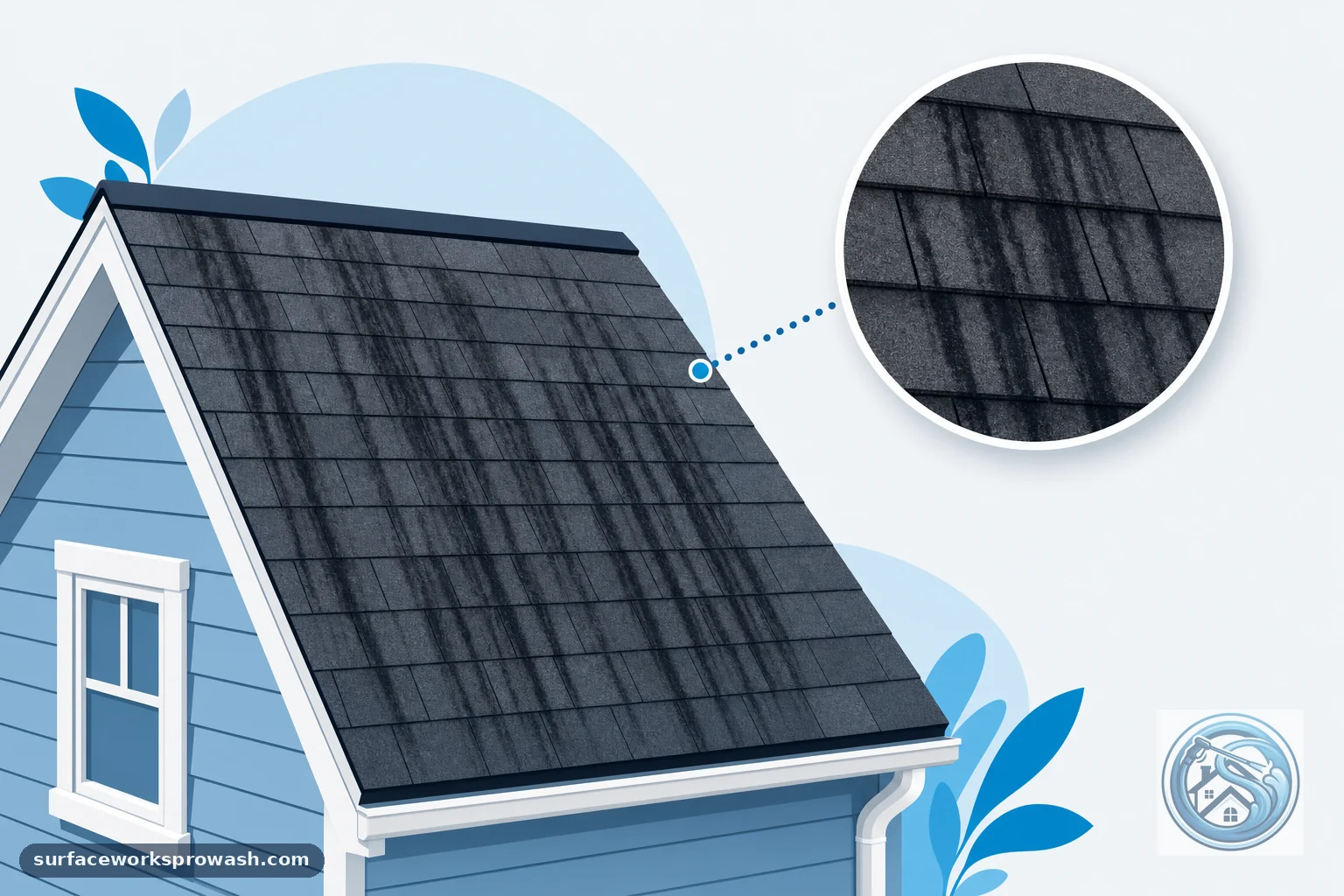
Those dark streaks running down a shingle roof are algae — specifically Gloeocapsa magma, a blue-green cyanobacteria. It spreads by airborne spores, feeds on the limestone filler in the shingle granules, and produces a dark, UV-protective pigment as it grows. That pigment is the streak you’re seeing.
The Asphalt Roofing Manufacturers Association, the industry group representing shingle manufacturers, is direct about it: "There is no scientific evidence that algae is damaging to asphalt shingles." On its own, algae isn’t eating your shingles.
Curb appeal and resale value. Streaking is one of the fastest visual signals that a home hasn’t been maintained, even when the roof underneath is structurally fine — it’s one of the first things a buyer, an appraiser, or a neighbor notices.
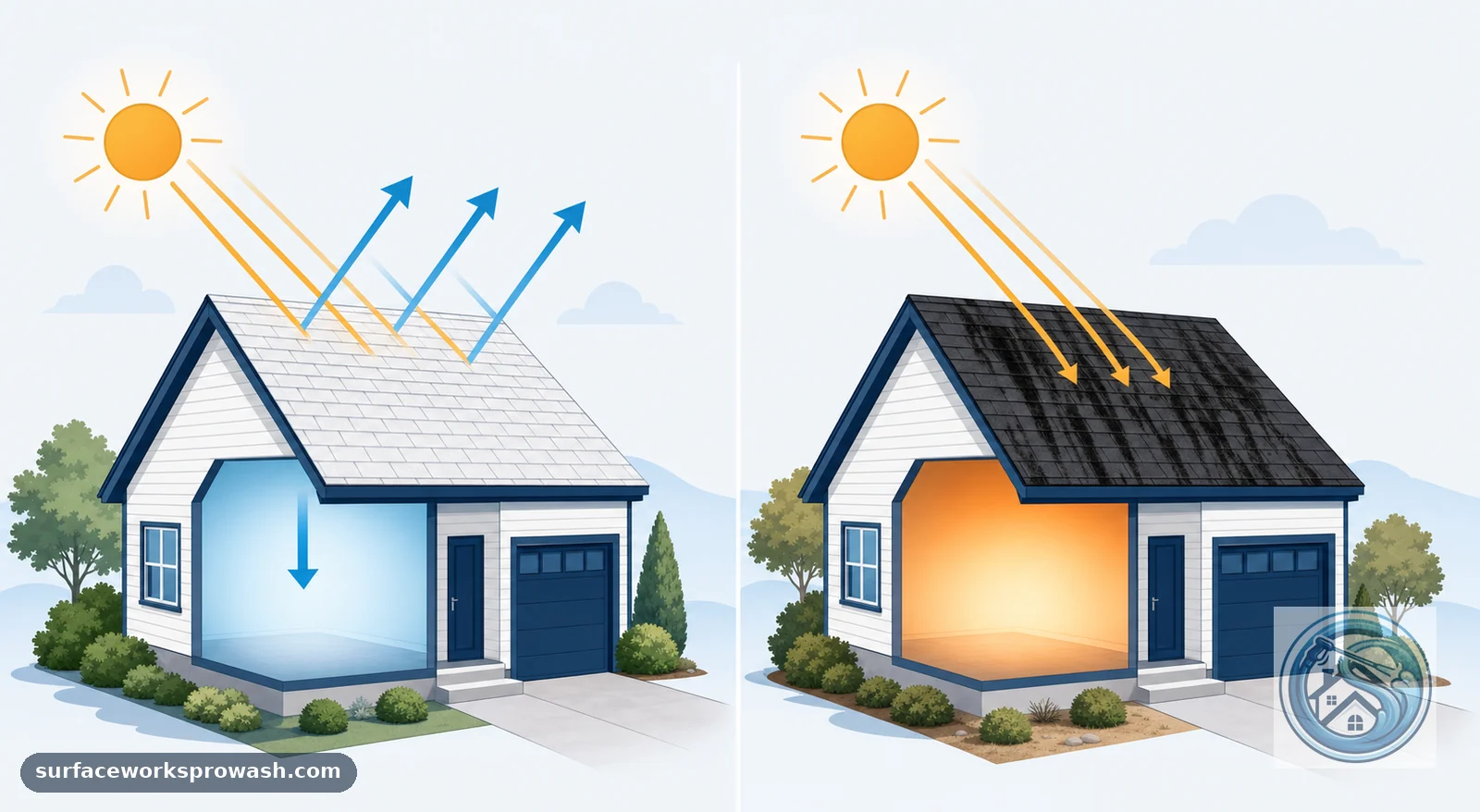
Energy costs, on reflective roofs. If the shingles are a lighter, reflective "cool roof" product, there’s a second, measurable effect. Those products are engineered to bounce sunlight away from the house instead of absorbing it. Black staining works directly against that: it darkens the surface and lowers the roof’s reflectivity, so it absorbs more heat than it was designed to. Cleaning it restores the reflectivity the product was built to provide.
But here’s the part that doesn’t get said enough. Algae not damaging the shingle directly doesn’t mean it’s fine to leave alone. Algae is living organic matter, and it’s growing on your roof because the surface is holding onto the moisture and organic buildup it needs to survive. That condition doesn’t resolve itself — and it’s the same condition moss and lichen need to move in next. Treating the staining now, while it’s still just staining, is the easiest point in the timeline to stop the cycle before it becomes a shingle-life problem instead of a cosmetic one.
Stage two: how algae opens the door for moss and lichen
Left untreated, algae growth doesn’t just sit there — it helps create the conditions for the next stage. Existing algae colonies provide organic nutrients and hold moisture against the shingle surface, and both of those are what allow moss and lichen to establish on the same roof over time. (Working RE / Nelms Inspections) That’s not algae turning into moss or lichen — they’re different organisms — but it is the same untreated buildup making the roof more hospitable to both.
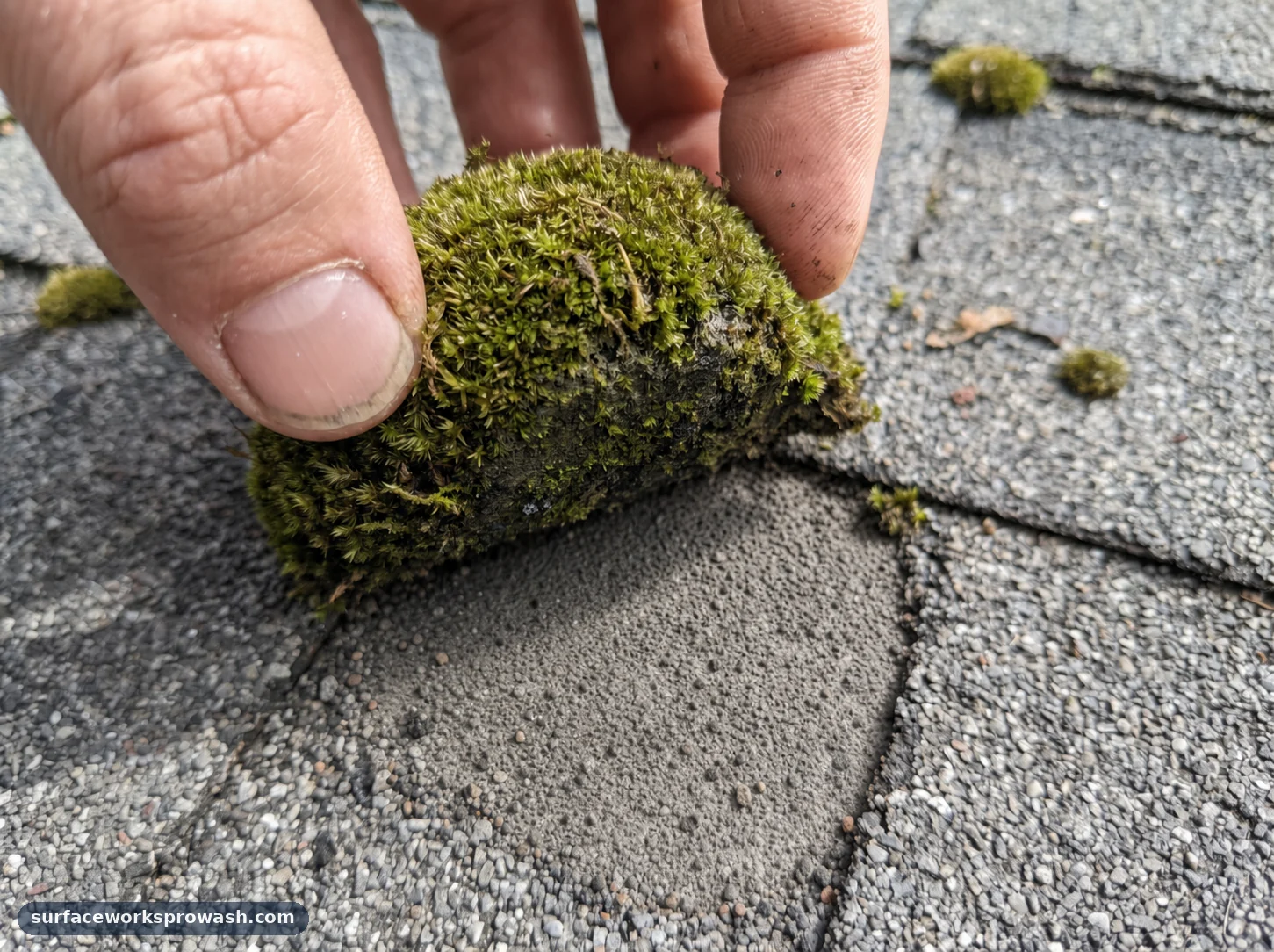
This is what that damage actually looks like underneath the growth. Lift a moss clump off the shingle and the patch it was sitting on is visibly different from the surrounding surface — rougher, flatter, and lighter than the pebbly, fully-granulated shingle around it, because the mineral granules that were there are gone. Those granules are the shingle’s only UV shield; once a patch loses them, that spot ages faster than the rest of the roof. None of this is visible from the ground. It’s hidden under the growth that caused it.
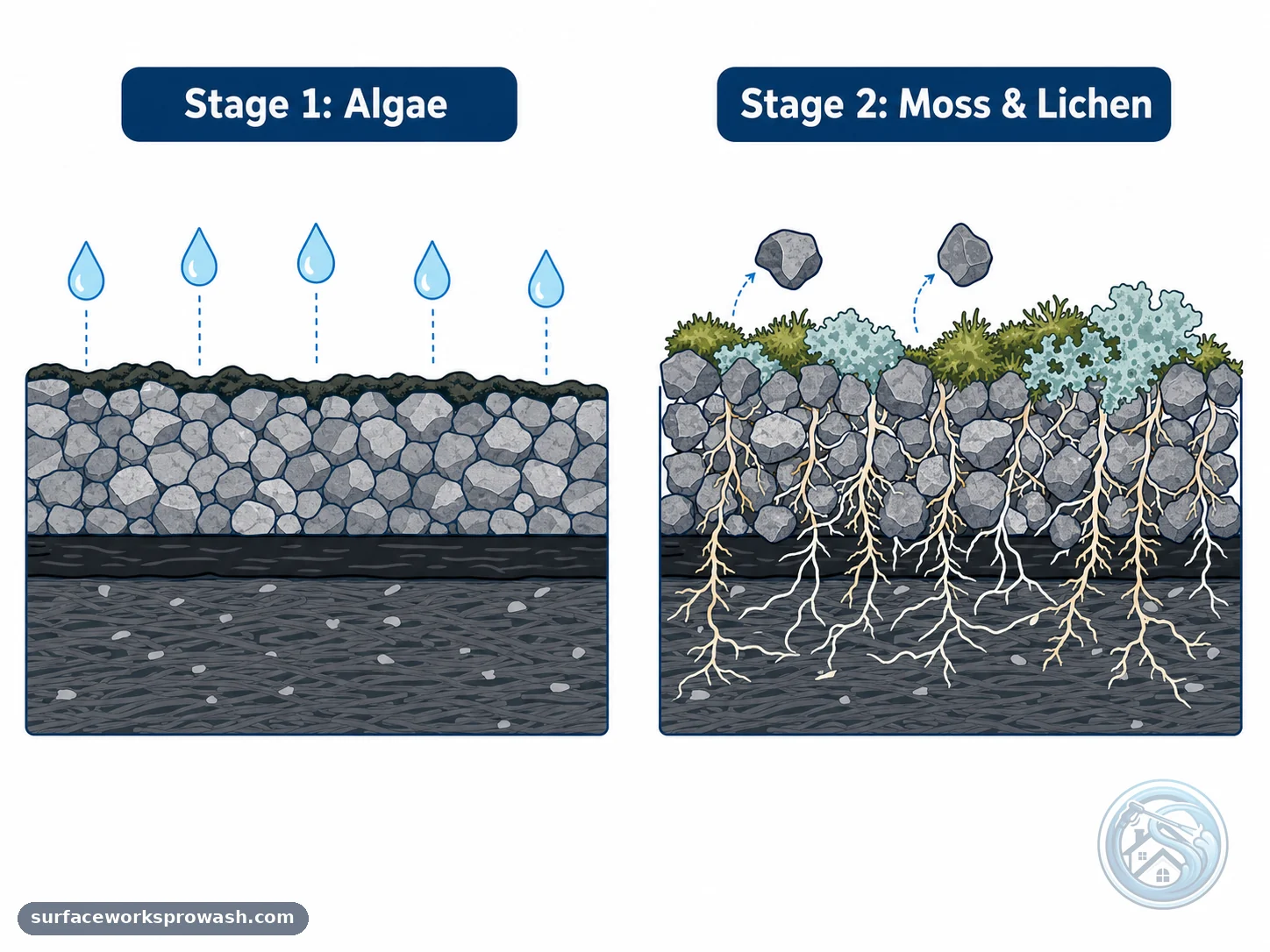
Moss is an actual plant. It anchors itself with rhizoids — small root-like structures that grow down into the shingle’s granule layer. As the moss mat grows, those rhizoids work further in, and the mat itself holds water against the shingle surface long after the rest of the roof has dried. That combination — mechanical penetration plus trapped moisture — is what does the damage. In freezing climates like Northeast Ohio, water held under a moss mat goes through repeated freeze-thaw cycles, which accelerates cracking and granule loss right where the moss is anchored. The Asphalt Roofing Manufacturers Association confirms moss can lift and curl shingle edges, which raises the risk of wind blow-off, and in severe cases lets water move laterally under the shingles toward the roof deck.
Lichen is different again. It’s not a single organism the way moss and algae are — it’s a fungus and an algae (or cyanobacteria) living together as one partnership. Its structures, called hyphae, grip the shingle surface tightly and bond directly to the mineral granules. Because that bond is so tight, lichen tends to pull granules away with it — whether it’s removed on purpose or by wind and weather. Once those granules are gone, the asphalt layer underneath has lost its UV shield and starts to age faster.
This is consistent with what shows up in the field: moss and lichen growth on a roof is a genuine indicator of accelerated wear, not just an appearance issue. By the time you’re looking at moss or lichen, you’re looking at the same organic-growth problem the black staining started as — just further along, and now actively shortening the roof’s life instead of just its curb appeal.
Why removal method changes the outcome, not just the process
Whatever stage is being treated — algae, moss, or lichen — how it’s removed matters as much as catching it early, because the wrong method can cause the exact damage the growth itself was already starting to cause.
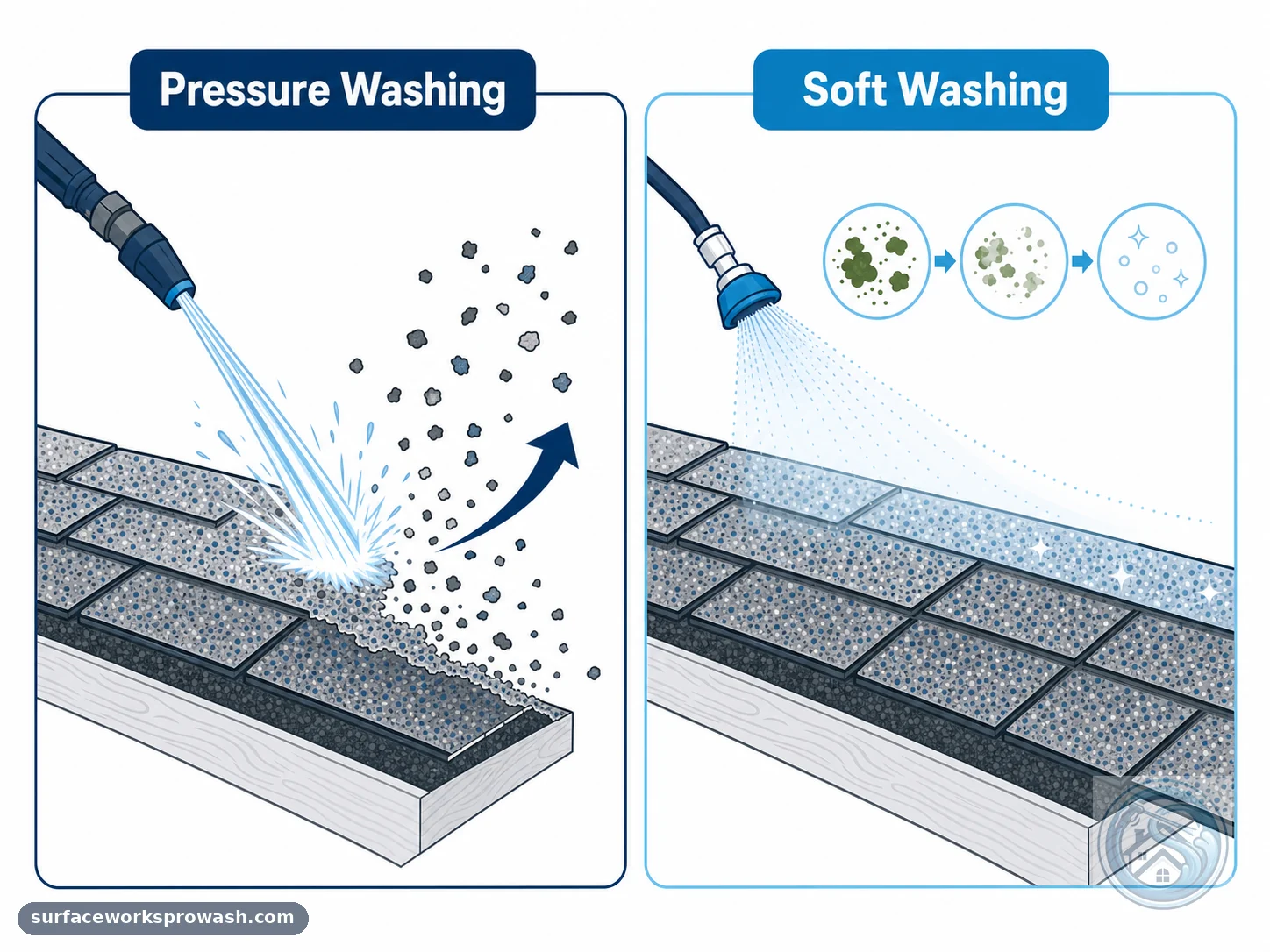
A pressure washer removes organic matter by force. It doesn’t kill algae, moss, or lichen at the root — it blasts the growth off the surface mechanically, and mineral granules go with it. That is not a fringe opinion; it is the explicit position of the manufacturers’ own trade association. The Asphalt Roofing Manufacturers Association states plainly: "Never use a pressure washer to clean an asphalt shingle roof as this will cause granule loss and very likely premature failure of the roof system." GAF’s own technical bulletin gives the same warning, noting that power washing "may dislodge granules, which can lead to premature shingle failure." Two competing shingle manufacturers, and the association that represents the entire industry, agree on this specific point.
Moss adds a second, more specific version of the same problem. Moss doesn’t sit loosely on top of a shingle — it anchors into the granule layer with rhizoids, so a live moss mat is physically gripping the granules underneath it. InspectApedia’s roofing guidance is direct about what happens when that grip is broken by force: "forcibly removing live lichens or moss from a roof [is] likely to damage the roof surface by pulling away the shingle granules." Scraping, aggressive brushing, and pressure washing all break that grip the same way — by force, while the moss is still alive and still attached to the granules it grew into.
Soft washing avoids that mechanism entirely. It doesn’t try to pull anything off the roof while it’s alive. The low-pressure cleaning solution kills algae, moss, and lichen at the root first, and only after the organism is dead does it release its grip. The Asphalt Roofing Manufacturers Association’s own maintenance guidance describes exactly that sequence: after the correct chemical treatment, "moss will loosen over time and may be removed with a leaf blower" — no scraping, no pressure, no force applied to granules that are still bonded to a living organism. That distinction — killing the growth versus tearing it off — is the entire reason soft washing removes moss and lichen without stripping the same granules a pressure washer or a scraper would take with it.
Related Questions
What is the difference between soft washing and pressure washing?
Soft washing uses low pressure and surface-appropriate cleaning solutions for delicate materials such as many roofs and siding types. Pressure washing is generally reserved for durable hard surfaces, such as applicable concrete. SurfaceWorks ProWash selects the method based on the material, condition, and project scope.
Do you guarantee your work?
Yes, on two different timelines, because roof work does not finish on the same clock as everything else. On any surface other than a roof: if you are not satisfied with something we cleaned, tell us within 14 days and we will come back and re-clean it at no charge. Fourteen days rather than a week on purpose — most people do not look properly until the following weekend, and a rain in between makes anyone doubt the result. On roof soft washing: 60 days. A roof keeps improving for four to six weeks after the visit as the treated moss and lichen lose their grip and release with rain and weather. Judging a roof at two weeks would be judging it half-finished. If it has not come around within 60 days, it gets re-treated at no charge. What the guarantee does not cover is anything cleaning cannot correct: oxidized or chalked finishes, concrete scaling where the top layer has already broken loose, failed paint or stain, and rust with an active source still feeding it. Those get identified on the walkthrough and stated before any work begins, so nothing on that list is a surprise afterward. Separately from all of that, there is a warranty. The guarantee above asks whether we did the job right; the warranty asks whether it stayed clean. Black streaking on a roof we soft washed is warranted for two years — three if you are on the maintenance plan — and washed siding can carry a twelve-month regrowth warranty, included free with the plan. Two conditions are excluded from the roof warranty and we point them out before the work rather than after: heavy overhanging tree cover, and areas where water pools rather than draining. Both re-seed growth continuously no matter how well a roof was cleaned. What the roof warranty covers, and how it compares to the five-year ones you will see online, is set out in [how to read a roof cleaning warranty](/learn/roof-cleaning-warranty-what-five-year-really-means). Roof pricing is on the [roof soft washing page](/services/roof-soft-washing). You can get your own number right now: the [instant estimate](/instant-estimate) prices your property from the address in about two minutes, and what you accept is what you pay.
Is roof cleaning safe for my roof?
A roof-cleaning method should match the roof material and condition. SurfaceWorks ProWash evaluates the roof before service and uses a low-pressure approach for applicable roofing materials rather than high pressure on standard asphalt shingles.
Will soft washing damage my roof shingles or siding?
Soft washing uses low pressure and a solution matched to the material, which is why it is the recommended method for shingles, painted wood, vinyl, and other surfaces that high pressure can damage. Concentration, dwell time, and rinse approach are adjusted to the surface and its condition rather than applied the same way everywhere.
Why can't you pressure wash a roof?
Standard asphalt shingles aren't designed for high pressure — it can strip the protective granules and shorten the roof's life. Soft washing uses low pressure and a solution matched to the material instead, which is why it's the recommended method for shingle roofs.
Can you wash a two-story or three-story house?
Yes. Upper stories are washed from the ground with low-pressure soft wash equipment that carries the solution up to the surface, which is safer for the house and for us than working a whole elevation off ladders. Height, roof pitch, landscaping, and access are all reviewed during the estimate because they change the plan and the time on site. A section that genuinely cannot be reached safely is identified during the estimate rather than discovered on the day — and on a three-story elevation the limiting factor is usually the ground beneath the reach point, not the height itself.
How do you get moss and lichen off a roof?
Moss and lichen are treated with a low-pressure soft wash solution that is left to work on the growth, not scraped, blown, or pressure-washed off. Lichen in particular anchors into the shingle surface, so it releases gradually over the following weeks with rain and weather rather than vanishing the day we leave. Scraping or high pressure would take shingle granules with it and shorten the roof’s life, which is why we don’t use them. Dislodged growth ends up in the gutters, which is why roof soft washing includes clearing out the trough and flushing the downspouts rather than treating that as an add-on. Leaving packed debris in place would just let it wash back out over everything that was cleaned. The gutter clean-out is free with a roof soft wash and 25% off added to a house wash, and the rate is published on the [pricing page](/pricing). More on what the gutters do to a roof in [black streaks, moss and lichen](/learn/roof-moss-lichen-algae-damage).
Learn More — what black streaks, moss, and lichen actually do to a roof
I have a single-story ranch in North Canton. What does a typical exterior cleaning cover?
On a one-story home a standard house wash covers the siding, soffit and fascia, and cleaning of the outside face of the gutters and downspouts, done as a low-pressure soft wash matched to vinyl, aluminum, or stone-veneer surfaces. Most North Canton homes we work on pair that with roof soft washing for shingle algae and with driveway or walkway cleaning, since the front approach is what shows from the street. The gutter clean-out is free with a roof soft wash and 25% off added to a house wash, and the rate is published on the [pricing page](/pricing). More on what the gutters do to a roof in [black streaks, moss and lichen](/learn/roof-moss-lichen-algae-damage).
My roof looks fine from the street but I was told it has algae. Which is it?
Both can be true, and on the newer Uniontown houses that is common. Architectural shingle roofs on wide, complex rooflines hold moisture in the valleys and on the north planes, and that is where the first algae establishes while the rest of the roof still looks new. So the visible face of the roof is the last place to check, not the first. We look at the valleys and shaded planes on the walk-through and tell you whether you are looking at early growth worth treating now or a roof that can wait — treating early is cheaper and easier than treating a fully streaked roof later.
Learn More — what black streaks, moss, and lichen actually do to a roof
Why does my 1970s Stow roof streak so badly on one side?
Because asphalt roofs on shaded north planes streak black with gloeocapsa growth, and on a low-pitch roof from that era the growth holds moisture against the shingle rather than shedding it. That is not just an appearance problem — moisture held against shingle is what shortens its life. The method is low-pressure soft washing that kills the growth and lets it release; walking or pressuring a roof that age takes granule off and is how a cleaning turns into a roofing conversation. We look at the shaded plane first and tell you what will clear and how long it takes.
Learn More — what black streaks, moss, and lichen actually do to a roof
More questions answered on the full FAQ page.
References
- Asphalt Roofing Manufacturers Association. (n.d.). https://www.asphaltroofing.org/algae-moss-prevention-cleaning-asphalt-roofing-systems/
- InspectApedia. (n.d.). https://inspectapedia.com/roof/Roof_Moss_Removal.php
- GAF Technical Advisory Bulletin TAB-R-102. (n.d.). https://www.gaf.com/en-us/document-library/documents/technical-bulletins-&-notes/r-102-algae-staining-on-shingled-roof-surfaces.pdf
- Working RE Magazine. (n.d.). https://www.workingre.com/algae-moss-and-lichen-on-roofs-how-it-affects-roof-shingles/