
Porch & Entryway Cleaning
Standalone porch or entryway cleaning for the high-visibility approach to a home.
$79. One price, one flat price.
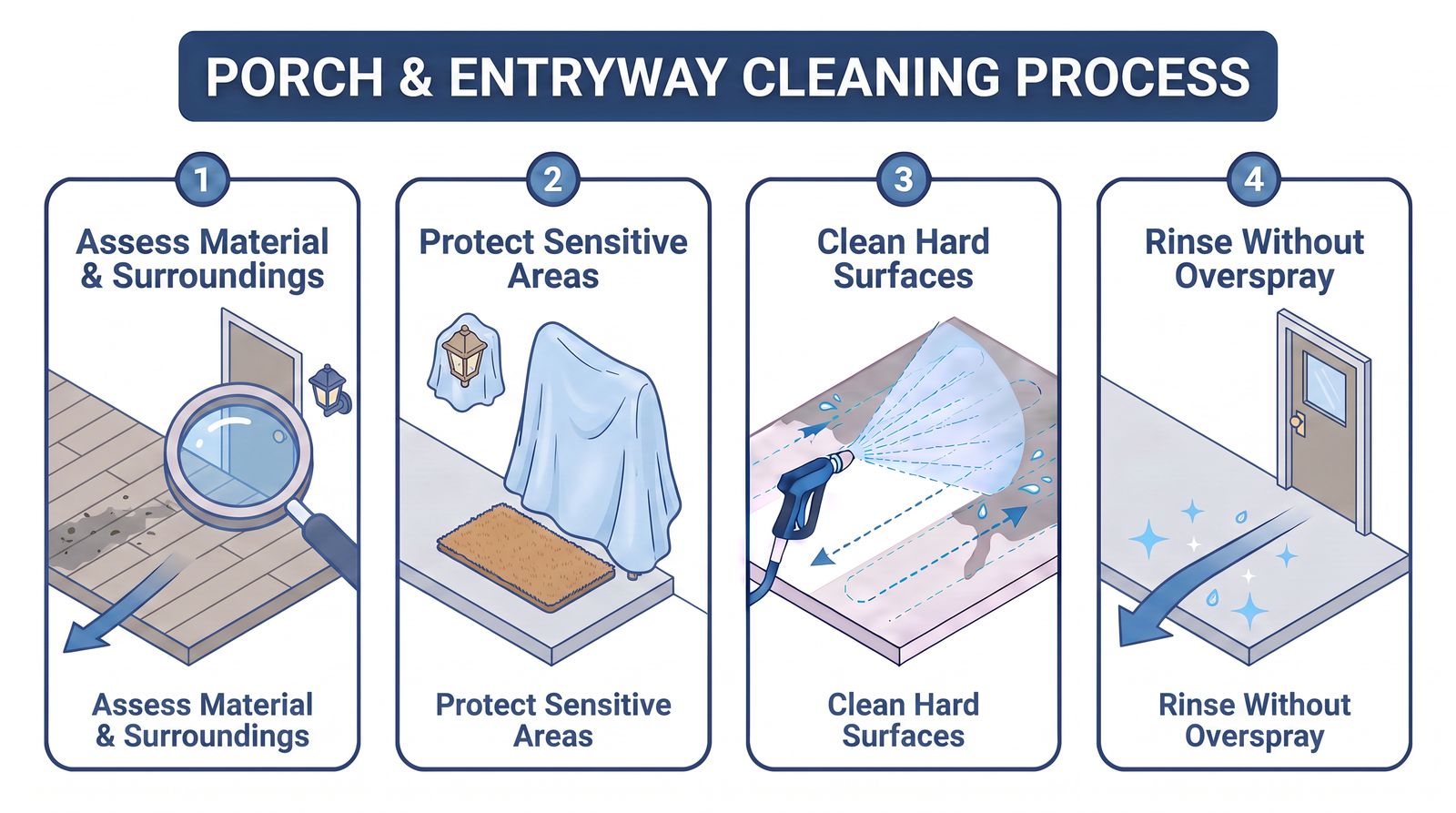
The material, the doors and fixtures nearby and where the water drains are assessed first, sensitive areas are protected, then the hard surfaces are cleaned and the approach rinsed without driving overspray into the entry itself.
The entry is the one surface on a property that every visitor stands on and looks down at, from close range, while they wait. It also collects a specific kind of soiling that the rest of the house does not — shoe traffic, tannin from whatever is planted beside it, and the runoff off a porch roof concentrating in one spot. It is a small surface with a disproportionate effect on how the whole house reads.
What to expect: Siding and railings above the entry are part of a house wash rather than this service.
Worth adding: House Wash. The entry is what someone sees from three feet away and the siding is what they saw from the street. The two together are what changes the impression.
Our Process
1. Assess Material & Surroundings. We assess the material, nearby doors, fixtures, and drainage before starting.
2. Protect Sensitive Areas. Sensitive areas are protected before cleaning begins.
3. Clean Hard Surfaces. We clean applicable hard surfaces.
4. Rinse Without Overspray. We rinse the approach without overspray into entry openings.
Porch & Entryway Cleaning by town
Where a town’s own surfaces are worth writing about separately, it has its own page — the same prices, with what actually weathers there and the sales tax for that county stated on it.
Our guarantee
If you are not satisfied with a surface we cleaned, tell us within 14 days and we will come back and re-clean it at no charge.
The guarantee covers cleaning. It does not cover conditions cleaning cannot correct — oxidized or chalked finishes, concrete scaling where the surface has already broken loose, failed paint or stain, and rust with an active source still feeding it. We identify those on the walkthrough and tell you before any work begins.
Common Questions
Is our patio and pool surround part of a house wash or a separate job?
Separate, and priced that way. The Canterbury-era estates carry the heaviest hardscape load anywhere in Hudson — patios, covered outdoor living areas, pergolas, outdoor fireplaces, built-in grills, in-ground pool surrounds and stone elevations. That is stone-and-masonry cleaning rather than house washing: different solutions, different pressure, joint-safe technique, and considerably more time on site. Bundling it into a house-wash number would either overprice the house or underprice the hardscape. So the estimate breaks them out and you can take either one on its own. You can get your own number right now: the [instant estimate](/instant-estimate) prices your property from the address in about two minutes, and what you accept is what you pay.
I heard some houses here are made of concrete panels. Does that change the cleaning?
Significantly, and it is the first thing we check for in this valley. The Buckeye Land Company estate is nearly 250 houses built in 1918 from factory-produced precast concrete panels, National Register listed since 1982, and precast concrete needs a very different approach than brick or siding — misidentifying it is how a house gets damaged. So the construction type is identified during the estimate rather than on the day, and it is written down along with the method that follows from it. Precast is recognizable once you know to look: large flat panels with regular vertical joints, and no wood anywhere in the wall.
My Glenmoor house is brick on the front and stucco on the sides. Is that one wash or two?
One visit, two methods. Houses here were built from 1991 onward and mixed elevations are the norm rather than the exception — brick running into stucco running into a frame gable on the same wall. Those surfaces do not take the same solution or the same pressure, and stucco in particular will hold a cleaning solution far longer than brick will, so a single blanket approach either undercleans the brick or overworks the stucco. Each material on the elevation gets its own method and its own line, because a number that does not name the materials cannot account for the difference between them. You can get your own number right now: the [instant estimate](/instant-estimate) prices your property from the address in about two minutes, and what you accept is what you pay.
We are still building. Is there anything worth doing before we move in?
Often yes, because construction leaves things on a surface that ordinary weather never would. Lots in the community are still being built on, and on a new build the usual candidates are mortar haze and splatter on masonry, footprint and tire staining on a brand-new drive and walk, and the general film that settles on an elevation over a year of trades working around it. New concrete is the one to be careful with: it needs time to cure before it is cleaned or sealed, so the right answer is sometimes to wait rather than to do it now. Where the build has got to is what decides it — some of this is worth doing before you move in, and some of it should wait for next season and warmer, drier conditions.
What is the difference between soft washing and pressure washing?
Soft washing uses low pressure and surface-appropriate cleaning solutions for delicate materials such as many roofs and siding types. Pressure washing is generally reserved for durable hard surfaces, such as applicable concrete. SurfaceWorks ProWash selects the method based on the material, condition, and project scope.
What is the difference between gutter cleaning, a gutter clean-out and gutter brightening?
Three different jobs on the same piece of metal. Gutter cleaning is the outside face of the gutter and downspout. It comes with a house wash or a siding cleaning at no extra cost. A gutter clean-out is interior work: removing packed leaves, shingle grit and sediment from inside the trough, then flushing each downspout to confirm water runs through it. It is included free with roof soft washing, because roof work puts debris into the gutters by design. It is also sold on its own, priced per linear foot, with no other service required. Gutter brightening removes the dark vertical striping bonded to the front face, often called tiger striping. That is oxidized aluminum and road film chemically stuck to the finish, so it needs a dedicated product and will not come off with house wash solution. It is never included in a house wash. A quick way to tell what you need: if the inside is full, you need a clean-out. If the outside is streaked dark, you need brightening. If neither, the cleaning that comes with your wash is enough. The gutter clean-out is free with a roof soft wash and 25% off added to a house wash, and the rate is published on the [pricing page](/pricing). More on what the gutters do to a roof in [black streaks, moss and lichen](/learn/roof-moss-lichen-algae-damage). Why a wash leaves chalky siding chalky-looking, and what actually improves it, is explained in [why a wash will not bring the color back](/learn/why-a-house-wash-will-not-fix-chalky-siding). You can get your own number right now: the [instant estimate](/instant-estimate) prices your property from the address in about two minutes, and what you accept is what you pay.
Do you guarantee your work?
Yes, on two different timelines, because roof work does not finish on the same clock as everything else. On any surface other than a roof: if you are not satisfied with something we cleaned, tell us within 14 days and we will come back and re-clean it at no charge. Fourteen days rather than a week on purpose — most people do not look properly until the following weekend, and a rain in between makes anyone doubt the result. On roof soft washing: 60 days. A roof keeps improving for four to six weeks after the visit as the treated moss and lichen lose their grip and release with rain and weather. Judging a roof at two weeks would be judging it half-finished. If it has not come around within 60 days, it gets re-treated at no charge. What the guarantee does not cover is anything cleaning cannot correct: oxidized or chalked finishes, concrete scaling where the top layer has already broken loose, failed paint or stain, and rust with an active source still feeding it. Those get identified on the walkthrough and stated before any work begins, so nothing on that list is a surprise afterward. Separately from all of that, there is a warranty. The guarantee above asks whether we did the job right; the warranty asks whether it stayed clean. Black streaking on a roof we soft washed is warranted for two years — three if you are on the maintenance plan — and washed siding can carry a twelve-month regrowth warranty, included free with the plan. Two conditions are excluded from the roof warranty and we point them out before the work rather than after: heavy overhanging tree cover, and areas where water pools rather than draining. Both re-seed growth continuously no matter how well a roof was cleaned. What the roof warranty covers, and how it compares to the five-year ones you will see online, is set out in [how to read a roof cleaning warranty](/learn/roof-cleaning-warranty-what-five-year-really-means). Roof pricing is on the [roof soft washing page](/services/roof-soft-washing). You can get your own number right now: the [instant estimate](/instant-estimate) prices your property from the address in about two minutes, and what you accept is what you pay.
Can you clean my patio furniture while you are doing the patio?
Yes, and it is the sensible time to do it since everything has to come off the patio anyway. Patio and outdoor furniture and equipment cleaning is $79 and covers furniture, swing sets, grills and similar outdoor items, cleaned at a pressure and solution matched to the material. Cushions and fabric are not included — this is hard surfaces: frames, tables, slides, plastic and metal. You can get your own number right now: the [instant estimate](/instant-estimate) prices your property from the address in about two minutes, and what you accept is what you pay.
Do you charge more for a two-story house?
No. One price covers the house at that size, whether it is one story or two. A 1,200 square foot home is $299 either way, and a 2,000 square foot home is $349 either way — you read your price off the table without doing arithmetic or wondering which column applies to you. A second story does take longer and needs more reach, and that is already built into the size-based price rather than added on top. Genuine difficulty does carry an add-on: a third story, or an elevation that cannot be worked from the ground. Anything like that is identified while the property is walked and stated before the work starts, never added afterward. You can get your own number right now: the [instant estimate](/instant-estimate) prices your property from the address in about two minutes, and what you accept is what you pay.
When do I pay for the work?
Payment is due when the job is finished. You get an itemized invoice showing what was done and what each part cost, and you can settle it on the spot or from the invoice. Larger commercial projects can be set up on Net 30 terms instead, and recurring commercial and property-management accounts are invoiced on an agreed schedule rather than job by job. You can get your own number right now: the [instant estimate](/instant-estimate) prices your property from the address in about two minutes, and what you accept is what you pay.
More questions answered on the full FAQ page.