
Patio Cleaning
Cleaning for patios and outdoor living areas, including brick pavers, stamped concrete and poured slabs.
$169 to $429, by measured area. Find your size in the table below — every price is published, so you get a number without a visit or a phone call.
Patio Cleaning Prices
Patios, pavers and decorative concrete, by measured area.
| Size | Price | Added to a house or roof wash | Typical time on site |
|---|---|---|---|
| Up to 500 sq ft | $169 | $135 | 1 hr 15 min |
| 501 - 1,000 sq ft | $249 | $199 | 1 hr 45 min |
| 1,001 - 1,500 sq ft | $339 | $271 | 2 hr 15 min |
| 1,501 - 2,000 sq ft | $429 | $343 | 2 hr 45 min |
Added to a house wash or roof soft wash, this comes at the add-on price. The saving is real rather than a discount dressed up: the drive, the hookup, the mix and the pack-down are paid for by the first service on the visit, so the second one genuinely costs us less to do.
Included: Surface cleaning and an algaecide post-treatment.
Not included: Polymeric sand replacement is quoted per job and is done after cleaning, before any sealing.
The patio material and its drainage are identified, accessible furnishings are moved clear, a suitable treatment is applied and the surface is cleaned at controlled pressure. On pavers the passes run across the joint lines rather than along or into them, and the surrounding surfaces are rinsed carefully afterward.
A paver patio is held together by the sand in its joints. Pressure aimed into a joint removes that sand, and once enough of it is gone the pavers start to shift, rock underfoot and open up further every season. Cleaning across the joints gets the growth out of them without excavating them. Cleaning across the joints gets the growth out without excavating them, which is the difference between a clean patio and a patio that now needs re-sanding.
What to expect: If the joints were already depleted before we started, re-sanding will be needed either way and we will say so at the walkthrough rather than after. Polymeric sand replacement is quoted per job and is done after cleaning and before any sealing.
Worth adding: Concrete Sealing. Sealing a paver surface locks the joint sand down and slows the growth from coming back into it, which is where growth on a patio always starts.
The patio material and its drainage are identified, accessible furnishings are moved clear, a suitable treatment is applied and the surface is cleaned at controlled pressure. On pavers the passes run across the joint lines rather than along or into them, and the surrounding surfaces are rinsed carefully afterward.
A paver patio is held together by the sand in its joints. Pressure aimed into a joint removes that sand, and once enough of it is gone the pavers start to shift, rock underfoot and open up further every season. Cleaning across the joints gets the growth out of them without excavating them. Cleaning across the joints gets the growth out without excavating them, which is the difference between a clean patio and a patio that now needs re-sanding.
What to expect: If the joints were already depleted before we started, re-sanding will be needed either way and we will say so at the walkthrough rather than after. Polymeric sand replacement is quoted per job and is done after cleaning and before any sealing.
Worth adding: Concrete Sealing. Sealing a paver surface locks the joint sand down and slows the growth from coming back into it, which is where growth on a patio always starts.
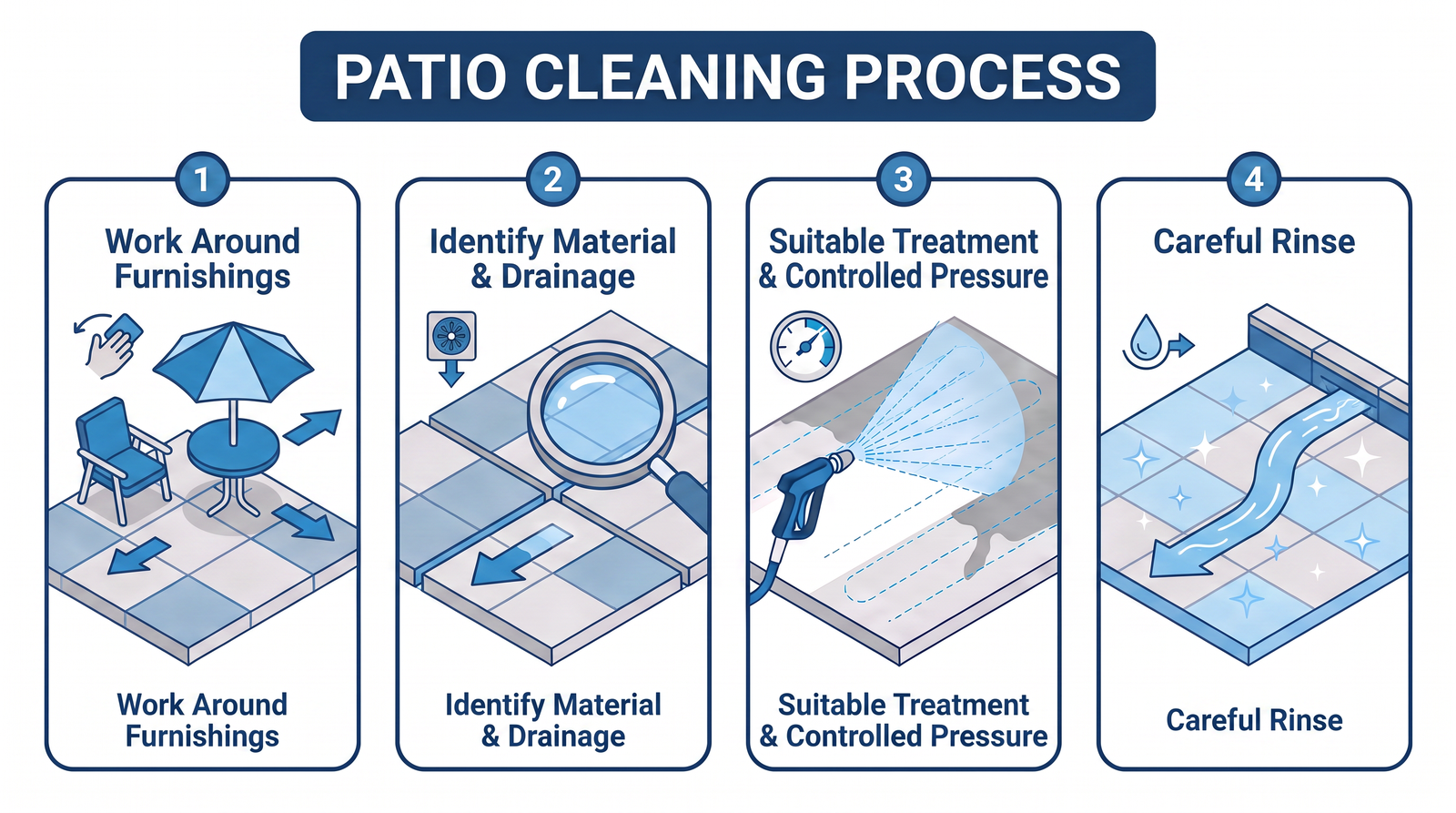
Our Process
1. Work Around Furnishings. We work around accessible patio furnishings rather than requiring a full teardown.
2. Identify Material & Drainage. We identify the patio material and drainage points before starting.
3. Suitable Treatment & Controlled Pressure. We apply a suitable treatment and use controlled cleaning pressure for the material.
4. Careful Rinse. We rinse surrounding surfaces carefully.
Patio Cleaning by town
Where a town’s own surfaces are worth writing about separately, it has its own page — the same prices, with what actually weathers there and the sales tax for that county stated on it.
Our guarantee
If you are not satisfied with a surface we cleaned, tell us within 14 days and we will come back and re-clean it at no charge.
The guarantee covers cleaning. It does not cover conditions cleaning cannot correct — oxidized or chalked finishes, concrete scaling where the surface has already broken loose, failed paint or stain, and rust with an active source still feeding it. We identify those on the walkthrough and tell you before any work begins.
Common Questions
Do you clean paver and stamped-concrete patios?
Yes. Patios are cleaned at a pressure matched to the material, which for pavers and stamped or decorative concrete means a gentler approach than a plain utility slab. On pavers we work in controlled passes to limit how much joint sand is disturbed, and we tell you if joints will need re-sanding afterward. Sealing is available as a follow-up once the surface is clean and dry.
Will cleaning my paver patio blow out the joint sand?
Not the way we do it, and this is the single most important method constraint on a paver job. Pavers are cleaned with pressure and angle controlled specifically to lift growth and staining without stripping the joints — because once the sand is gone you have a re-sanding job on top of the cleaning you just paid for, and unstable joints let pavers shift. The custom builds in Northampton and the river-view homes carry large paver and poured patios, retaining walls and pool decks, so this comes up constantly here. Joints that are already depleted will need sand regardless of how the cleaning is done, and that is identifiable before anything starts rather than discovered afterward.
Is our patio and pool surround part of a house wash or a separate job?
Separate, and priced that way. The Canterbury-era estates carry the heaviest hardscape load anywhere in Hudson — patios, covered outdoor living areas, pergolas, outdoor fireplaces, built-in grills, in-ground pool surrounds and stone elevations. That is stone-and-masonry cleaning rather than house washing: different solutions, different pressure, joint-safe technique, and considerably more time on site. Bundling it into a house-wash number would either overprice the house or underprice the hardscape. So the estimate breaks them out and you can take either one on its own. You can get your own number right now: the [instant estimate](/instant-estimate) prices your property from the address in about two minutes, and what you accept is what you pay.
I heard some houses here are made of concrete panels. Does that change the cleaning?
Significantly, and it is the first thing we check for in this valley. The Buckeye Land Company estate is nearly 250 houses built in 1918 from factory-produced precast concrete panels, National Register listed since 1982, and precast concrete needs a very different approach than brick or siding — misidentifying it is how a house gets damaged. So the construction type is identified during the estimate rather than on the day, and it is written down along with the method that follows from it. Precast is recognizable once you know to look: large flat panels with regular vertical joints, and no wood anywhere in the wall.
We are still building. Is there anything worth doing before we move in?
Often yes, because construction leaves things on a surface that ordinary weather never would. Lots in the community are still being built on, and on a new build the usual candidates are mortar haze and splatter on masonry, footprint and tire staining on a brand-new drive and walk, and the general film that settles on an elevation over a year of trades working around it. New concrete is the one to be careful with: it needs time to cure before it is cleaned or sealed, so the right answer is sometimes to wait rather than to do it now. Where the build has got to is what decides it — some of this is worth doing before you move in, and some of it should wait for next season and warmer, drier conditions.
What is the difference between soft washing and pressure washing?
Soft washing uses low pressure and surface-appropriate cleaning solutions for delicate materials such as many roofs and siding types. Pressure washing is generally reserved for durable hard surfaces, such as applicable concrete. SurfaceWorks ProWash selects the method based on the material, condition, and project scope.
Can you clean my patio furniture while you are doing the patio?
Yes, and it is the sensible time to do it since everything has to come off the patio anyway. Patio and outdoor furniture and equipment cleaning is $79 and covers furniture, swing sets, grills and similar outdoor items, cleaned at a pressure and solution matched to the material. Cushions and fabric are not included — this is hard surfaces: frames, tables, slides, plastic and metal. You can get your own number right now: the [instant estimate](/instant-estimate) prices your property from the address in about two minutes, and what you accept is what you pay.
How do you manage work areas and runoff?
Every project begins with a site-specific plan. For commercial and vehicle-heavy properties, we review drainage, nearby storm drains, access, operating hours, containment needs, and wastewater-recovery requirements before service begins.
Do you offer concrete sealing as a follow-up service?
Yes. Sealing a driveway, patio, or walkway after cleaning helps protect the surface from staining, moisture, and future buildup. Sealed concrete typically stays protected longer than unsealed concrete — up to about 3 years depending on traffic and exposure — so it's worth asking about when you request a quote. The [maintenance plan](/maintenance-plan) is built for exactly this: an autumn visit, next year's price held, and a longer roof warranty. You can get your own number right now: the [instant estimate](/instant-estimate) prices your property from the address in about two minutes, and what you accept is what you pay.
How do you clean a wood or composite deck without damaging it?
Decks are cleaned with a surface-appropriate solution and controlled pressure suited to the decking material, not the pressure used on concrete. Wood is worked with the grain so boards aren’t furred or gouged, and composite is cleaned with a low-pressure wash and solution so the embossed surface isn’t scarred. We inspect boards, railings, and fasteners first and clear accessible furnishings before starting, and we point out any soft or failing boards we find.
More questions answered on the full FAQ page.