
Exterior Surface Cleaning
A custom service for exterior areas beyond a standard category, such as stucco or brick.
Our Process
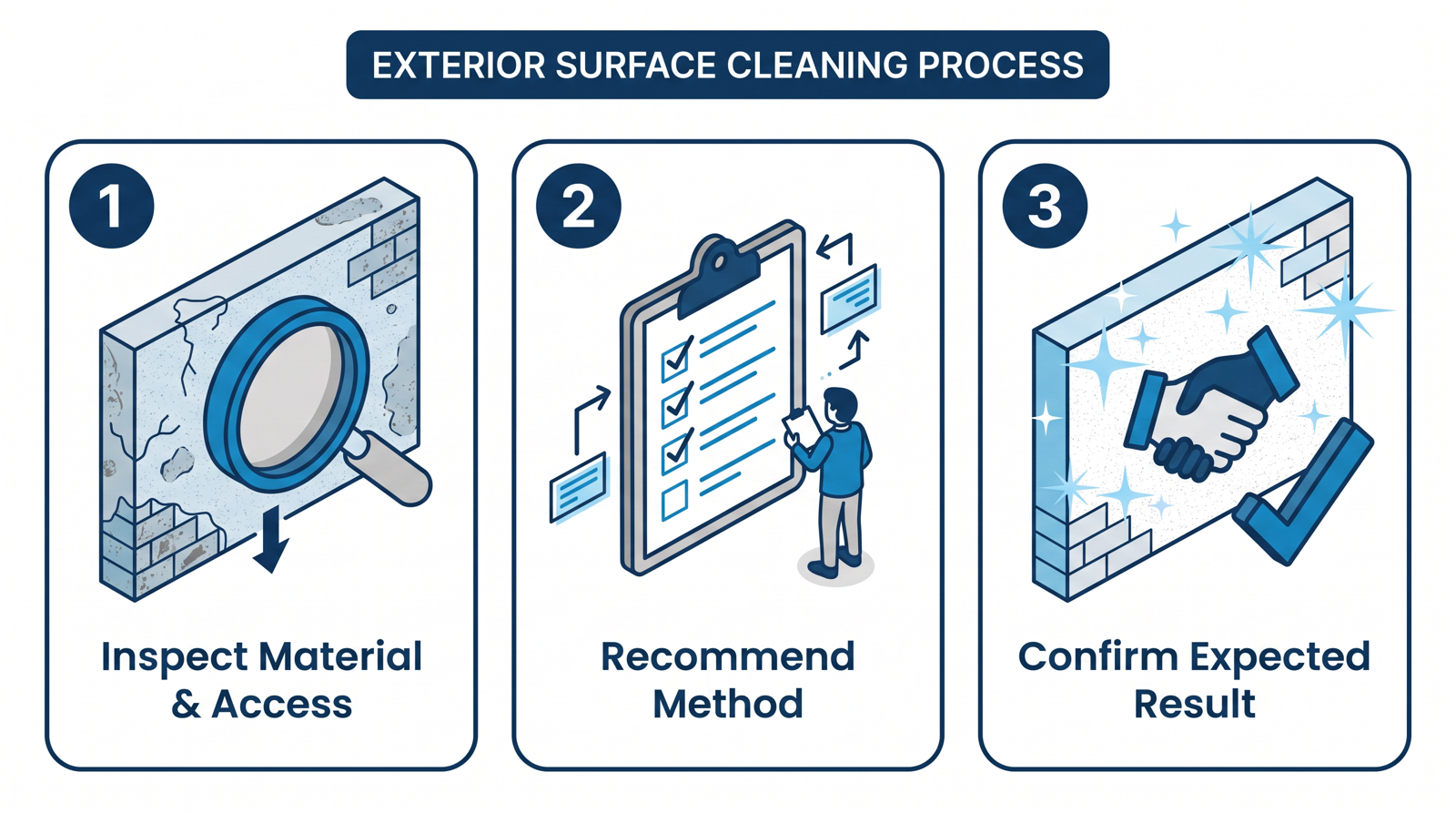
1. Inspect Material & Access. We inspect the material, access, condition, and drainage before recommending anything.
2. Recommend Method. We recommend the appropriate method and preparation steps based on that assessment.
3. Confirm Expected Result. We confirm the expected result with you before work begins.
Exterior Surface Cleaning by town
Where a town’s own surfaces are worth writing about separately, it has its own page — the same prices, with what actually weathers there and the sales tax for that county stated on it.
Our guarantee
If you are not satisfied with a surface we cleaned, tell us within 14 days and we will come back and re-clean it at no charge.
The guarantee covers cleaning. It does not cover conditions cleaning cannot correct — oxidized or chalked finishes, concrete scaling where the surface has already broken loose, failed paint or stain, and rust with an active source still feeding it. We identify those on the walkthrough and tell you before any work begins.
Common Questions
What makes cleaning on Fourth Street different?
Fourth Street is where Massillon's oldest houses are, with Five Oaks Mansion anchoring the district, and that is period masonry and painted wood where the wrong pressure shows up permanently and does not wash back off. So the method is conservative by default: correct chemistry, low pressure, generous dwell time, controlled rinse, and a willingness to leave a surface alone if cleaning it would cost more than it gains. Some sections of a house that age are better left until the underlying material is repaired — failed paint will not survive a wash, and etched period brick does not wash back off.
Is stone and aged mortar safe to clean?
Only at controlled low pressure. Early-twentieth-century estate architecture in this area, Stewart Manor being the obvious example, looks durable and is not — pressure opens mortar joints and etches stone faces, and neither washes back off. The solution and the dwell time carry the work, with a test on any material whose condition is uncertain. Some sections of a very old wall are better left until the mortar is repointed; cleaning a failing joint drives water into it.
My Hudson house is in the historic district. Is there anything I need to check first?
Possibly, and it is worth checking before we schedule. The Hudson Historic District has been on the National Register since November 1973 and was expanded in October 1989 to take in Hudson, Old Orchard, Aurora, Oviatt, Streetsboro and College streets. Because exterior changes on placarded properties can require review, we treat that work as restoration-grade cleaning and talk through scope with you before anything begins. On the material side, Federal and Greek Revival houses from the 1830s through the 1920s are the most method-sensitive properties in our whole service area — soft mortar and original painted wood, cleaned at low pressure with correct dwell time or not touched at all.
Can a house that is almost two centuries old be washed safely?
Low-pressure soft washing, with chemistry chosen for the material rather than for speed. Beall Avenue is the historic artery running through the College of Wooster, lined with historic homes and churches — First Presbyterian is neo-gothic with a 1927 cornerstone — and the Wayne County Historical Society is restoring the Beall House, the oldest historic house still standing in the city. Some of that material is approaching two centuries old, which makes cleaning there appearance work on things that cannot be replaced. We test where material is uncertain, keep the rinse out of mortar joints, and will tell you if a surface should be left alone.
Is my brick house safe to pressure wash?
Masonry-safe chemistry with a controlled rinse, and it applies across a lot of the city. Colonial Revival is described as extremely popular in Mansfield and is often brick, so that method is the default rather than the exception here. The rinse is the part that matters most: brick tolerates the solution far better than it tolerates water pushed into a joint at pressure. Mansfield also treats a lot of its older housing as worth protecting — The Boulevards, Sherman's Estate and Central Park are historic districts already, and the city's preservation plan points at Woodland, Ranchwood and Marion Avenue as likely additions.
Can brick and masonry be cleaned without damaging the mortar?
Yes, when the pressure is kept off it. Brick, block, and stone are cleaned with a low-pressure application and a solution appropriate to masonry, because aged or soft mortar joints erode under pressure that modern concrete shrugs off. We check joint condition, prior coatings or paint, and window and door openings first, and test an inconspicuous area when the material is uncertain. Where joints are already failing, we tell you that cleaning will reveal it rather than hide it.
Can you clean older brick buildings and storefronts in downtown Massillon?
Yes. Older brick and mortar is cleaned at low pressure with a solution appropriate to masonry, because aged joints and softer historic brick erode under pressure that plain modern concrete tolerates. We check joints, prior coatings or paint, and window and door openings before choosing a method, and test an inconspicuous area when the material is uncertain. Storefront approaches, entry pads, and sidewalks are usually cleaned during the same visit so the whole frontage matches.
I own a home in a historic district. How do you clean it without harming original materials?
Historic exteriors get the gentlest method that will do the job: low-pressure soft washing, solutions matched to the material, and a test in an inconspicuous area before committing to an approach. Original brick, aged mortar, wood clapboard, painted trim, and old glazing all fail under pressure that modern vinyl shrugs off, so pressure is not the tool. We inspect for failing paint, open joints, and loose material first and tell you what we would leave alone. Districts like these are part of our regular work in Canton’s Ridgewood area, Medina, Wooster, and Mansfield.
My historic district has appearance standards. Do you work within those?
Yes. Where a district or review commission sets appearance standards, the safe path is cleaning that removes soiling and organic growth without altering the material or its finish, which is what soft washing is for. We do not sandblast, strip, or apply coatings to a historic facade, and we don’t treat a cleaning as an opportunity to change how a building looks. Confirm any approval requirement with your local commission before scheduling, and we can provide a written scope stating exactly what will be cleaned and by what method so you have something to submit.
My house is in Ridgewood. Can it be cleaned without damaging the brick or mortar?
Yes, but only at low pressure. The Tudor, Georgian and French-Norman houses in Ridgewood were architect-built in the early 1900s, and their brick, mortar and painted wood will not tolerate pressure that modern concrete shrugs off. We clean them with the correct solution and enough dwell time to do the lifting, then rinse in a controlled way that keeps water out of the joints. Because the district has been on the National Register since 1982 and its look is part of what people bought into, the standard we work to is that the job leaves no etching, no striping and no damaged mortar behind.
More questions answered on the full FAQ page.