
Driveway Cleaning
Cleaning for concrete driveways affected by oil stains, tracked-in dirt, tire marks, and weathering.
$119 to $189, by single, two or three car — longer and rural drives are measured by area. Find your size in the table below — every price is published, so you get a number without a visit or a phone call.
Driveway Cleaning Prices
Single, two and three car. Longer and rural driveways are measured and priced by area.
| Size | Price | Typical time on site |
|---|---|---|
| Single-car driveway (up to ~400 sq ft) | $119 | 45 min |
| Two-car driveway (~400 - 700 sq ft) | $169 | 1 hr |
| Three-car driveway (~700 - 1,000 sq ft) | $189 | 1 hr 30 min |
| Over 1,000 sq ft - measured and priced by area | $0.19 / sq ft | — |
Included: Surface cleaning and an algaecide post-treatment.
Not included: Oil and rust stains are treated separately. Sealing is quoted per job.
The area is cleared, then spots are pre-treated before anything general happens — oil, rust and tannin each need their own product and none of them respond to the one that lifts organic growth. The slab is cleaned in controlled overlapping passes with a surface cleaner rather than a wand, edges and transitions are detailed by hand, and residue is rinsed away from the house rather than toward it. An algaecide post-treatment goes down at the end.
A wand leaves stripes. It cleans a fan-shaped patch at whatever pressure it is set to, and the overlaps show as light and dark banding forever after in the right light. A surface cleaner holds a constant distance and constant pressure across the whole slab, which is what produces an even finish. Pressure is also the thing that ruins concrete: too much opens the aggregate, and once the surface is opened it holds dirt faster and takes salt deeper every winter after.
What to expect: Organic staining and general grime come up. What will not come up is scaling — where the top layer of concrete has already broken loose from freeze-thaw and salt — and no amount of pressure changes that, it only makes it worse. We will point out which is which on the walkthrough so you know what you are paying for.
Worth adding: Sidewalk & Walkway Cleaning. The drive and the front walk are read as one surface from the street. Cleaning one and not the other makes the difference obvious rather than invisible.
The area is cleared, then spots are pre-treated before anything general happens — oil, rust and tannin each need their own product and none of them respond to the one that lifts organic growth. The slab is cleaned in controlled overlapping passes with a surface cleaner rather than a wand, edges and transitions are detailed by hand, and residue is rinsed away from the house rather than toward it. An algaecide post-treatment goes down at the end.
A wand leaves stripes. It cleans a fan-shaped patch at whatever pressure it is set to, and the overlaps show as light and dark banding forever after in the right light. A surface cleaner holds a constant distance and constant pressure across the whole slab, which is what produces an even finish. Pressure is also the thing that ruins concrete: too much opens the aggregate, and once the surface is opened it holds dirt faster and takes salt deeper every winter after.
What to expect: Organic staining and general grime come up. What will not come up is scaling — where the top layer of concrete has already broken loose from freeze-thaw and salt — and no amount of pressure changes that, it only makes it worse. We will point out which is which on the walkthrough so you know what you are paying for.
Worth adding: Sidewalk & Walkway Cleaning. The drive and the front walk are read as one surface from the street. Cleaning one and not the other makes the difference obvious rather than invisible.
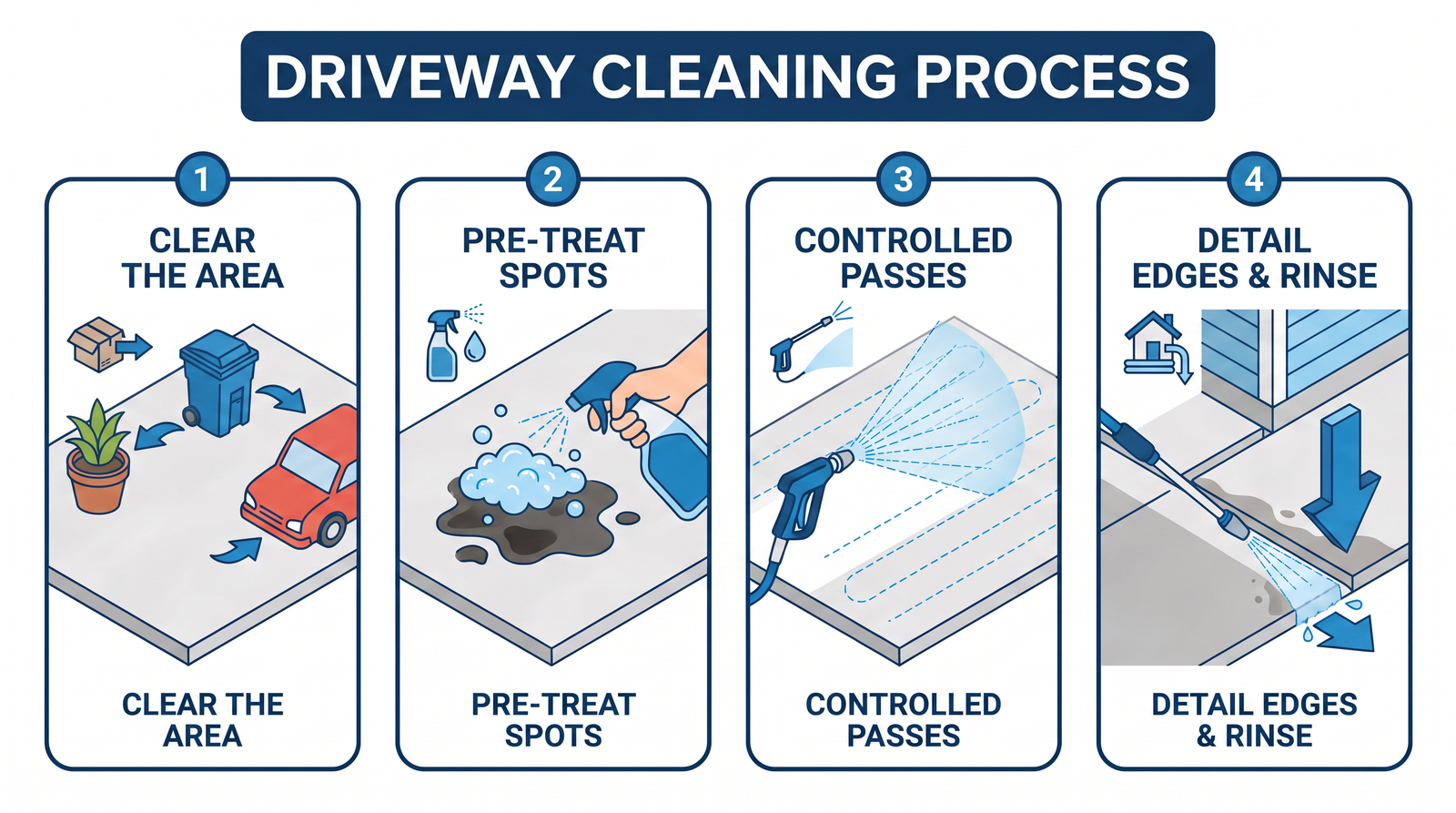
Our Process
1. Clear the Work Area. We clear the driveway of vehicles, debris, and obstacles before starting.
2. Pre-Treat Spots. Applicable spots — like tire marks or tracked-in dirt — are pre-treated.
3. Controlled Passes. We clean the concrete in controlled passes for a more even finish.
4. Detail Edges & Rinse. We detail edges and transitions, and rinse residue away from the home.
Driveway Cleaning by town
Where a town’s own surfaces are worth writing about separately, it has its own page — the same prices, with what actually weathers there and the sales tax for that county stated on it.
Our guarantee
If you are not satisfied with a surface we cleaned, tell us within 14 days and we will come back and re-clean it at no charge.
The guarantee covers cleaning. It does not cover conditions cleaning cannot correct — oxidized or chalked finishes, concrete scaling where the surface has already broken loose, failed paint or stain, and rust with an active source still feeding it. We identify those on the walkthrough and tell you before any work begins.
Common Questions
Can you remove rust or oil stains?
SurfaceWorks ProWash offers targeted treatment for applicable rust and oil or vehicle-fluid staining. Results depend on stain age, material condition, surface porosity, and prior treatment attempts.
Can you get oil spots and tire marks off my driveway?
Oil, transmission fluid, and tire marking are treated as their own step, with a targeted pre-treatment applied to those spots before the concrete is cleaned in passes. Fresh surface oil usually comes up well, while fluid that has soaked deep into older, porous concrete tends to lighten rather than disappear. We look at stain age, how porous the slab is, and whether anything has been applied to it before, then tell you what to expect before we start.
Can decades of road salt come out of my Canton driveway?
Partly — and here is the line between what lifts and what does not. Canton concrete is generally old poured concrete — aprons, front walks and porch slabs that have absorbed years of de-icing salt, tree tannin and traffic. Surface-cleaner passes plus targeted stain treatment lift the organic staining and much of the discoloration. What they do not do is reverse scaling, where the salt has already broken the top layer loose; more pressure there just opens the aggregate further and makes it worse. On the estimate we separate what will clean from what is permanent surface damage, so you know what you are buying.
The original driveway on my 1950s Massillon house looks rough. Worth cleaning?
Usually yes, with a clear expectation set first. Out from the core you get 1950s raised ranches and midcentury singles whose original concrete drives and porch slabs are the real problem — decades of de-icing salt, tree tannin and tire traffic. The right approach is a surface cleaner plus stain treatment, not more pressure, because pressure on concrete that age opens the aggregate. On the walk-through we separate the organic staining and tannin that will release from the scaling and wear that will not. That way the number you get matches the result you get.
The rust stain on my concrete keeps coming back. Why?
Because rust staining has a source, and until the source is dealt with the stain returns no matter how well it was treated. On light gray concrete it reads obviously, which is why owners here notice it early. Common sources are fertilizer with iron content, a metal fixture or railing shedding onto the slab, well water with iron in it running through an irrigation head, or something metal that was left sitting. On the estimate we treat the stain and tell you what we think is feeding it, because otherwise you are paying for the same removal every season.
What can be done about my old Stow driveway?
Surface cleaning plus targeted stain treatment, which does far more here than raw pressure. Concrete drives from the same era as most of these houses have absorbed thirty to fifty winters of de-icing salt, and pressure on concrete in that condition just opens the aggregate and leaves you worse off. Surface cleaning lifts the organic staining and much of the general discoloration, and stain treatment goes after rust and oil specifically. What none of it reverses is scaling where the top layer has already broken loose. We separate those two on the estimate so the number matches the outcome.
Our newer Wooster house has a long driveway. Is young concrete worth cleaning?
Yes, and usually sooner than people think. Newer large-lot builds at Deer Creek and Ashton Village put the emphasis on concrete — long drives, wide aprons, walkways and patios — and light, relatively young concrete shows organic growth and staining early, because the surface is still pale and tight enough that anything on it reads clearly. Cleaning it early is also easier and cheaper than letting growth establish. We measure the actual square footage on the walk-through rather than estimating from the street, since a long drive and a wide apron are the whole cost on a property like that. You can get your own number right now: the [instant estimate](/instant-estimate) prices your property from the address in about two minutes, and what you accept is what you pay.
Are paver drives cleaned differently than the poured concrete ones?
Yes, and the difference is joint sand. Drives here are a mix of poured concrete and pavers on lots running from roughly a third of an acre to well over an acre, so this is measured work rather than a flat price. On poured concrete we use surface-cleaner passes at a pressure the slab can take. On pavers we work in controlled passes specifically to limit how much joint sand we pull out, and if the joints will need re-sanding afterward we tell you that up front rather than after — re-sanding is a normal part of maintaining a paver drive, not a sign something went wrong. Sealing, on either surface, is a follow-up once things are clean and fully dry. You can get your own number right now: the [instant estimate](/instant-estimate) prices your property from the address in about two minutes, and what you accept is what you pay.
Do you offer concrete sealing as a follow-up service?
Yes. Sealing a driveway, patio, or walkway after cleaning helps protect the surface from staining, moisture, and future buildup. Sealed concrete typically stays protected longer than unsealed concrete — up to about 3 years depending on traffic and exposure — so it's worth asking about when you request a quote. The [maintenance plan](/maintenance-plan) is built for exactly this: an autumn visit, next year's price held, and a longer roof warranty. You can get your own number right now: the [instant estimate](/instant-estimate) prices your property from the address in about two minutes, and what you accept is what you pay.
Will my concrete look brand new when you’re done?
Cleaning removes what is on and in the surface — dirt, algae, mildew, and much of the staining — but it does not change the concrete itself. Discoloration from aging, spalling, salt damage, failed sealer, or fluid that soaked deep into a porous slab can remain after a thorough cleaning, and decades of Ohio winters leave marks no pressure setting will undo. We tell you which marks we expect to come out and which are likely permanent when we look at the slab, and sealing afterward keeps the improved result cleaner longer.
More questions answered on the full FAQ page.